
How to Grow Your Small Business on Social Media in 2026
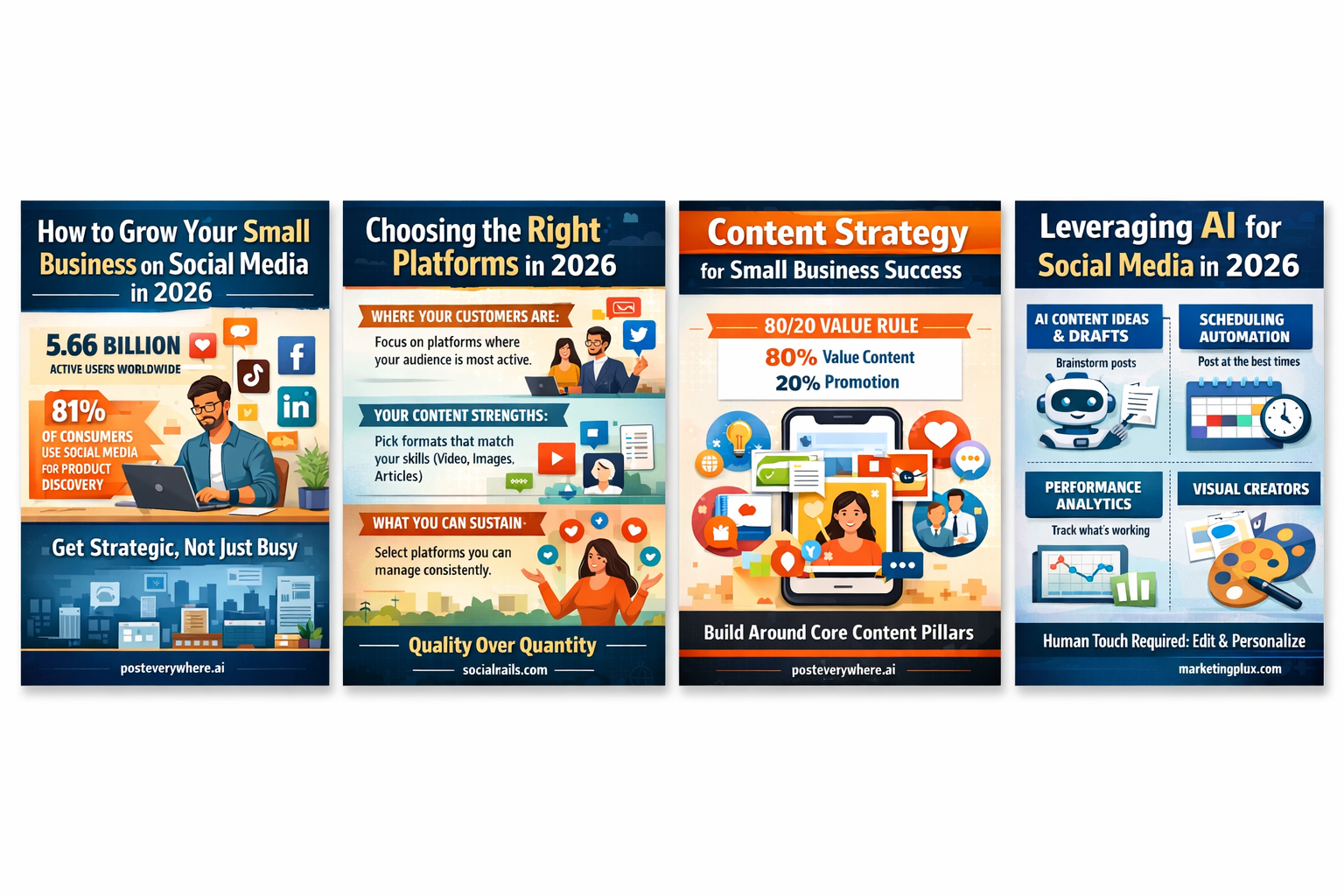
The social media landscape has shifted dramatically. With 5.66 billion active users worldwide and 81% of consumers now using social platforms for product discovery, the opportunity for small businesses has never been larger—or more competitive. posteverywhere.ai
Yet here’s the uncomfortable truth: only 29% of marketers have a documented social media strategy. Those who do are 414% more likely to report success. That’s not a marginal edge. That’s the difference between a channel that drives revenue and one that burns hours chasing vanity metrics. posteverywhere.ai
This guide breaks down exactly how small businesses can build sustainable social media growth in 2026—without massive budgets, dedicated teams, or burning out on the content treadmill. We’ll cover platform selection, content strategy, AI tools that actually help, and the measurement frameworks that separate thriving businesses from those stuck posting into the void.
Why Small Businesses Need a Different Playbook
Small businesses operate under constraints that enterprise brands don’t face. Limited time, limited budget, limited staff—often with the owner handling social media between customer calls and inventory management.
But constraints can become advantages. Small businesses possess something large corporations spend millions trying to manufacture authenticity. socialrails.com
Your local connections translate to built-in audience support. Your agility means you can respond to trends while enterprise brands are still waiting for approval chains. Your personal involvement creates genuine brand personality that no corporate social media team can replicate.
The playbook that works for Fortune 500 companies—posting five times daily across seven platforms with a team of twelve—will exhaust a small business owner within weeks. Instead, the approach that works focuses on depth over breadth, community over broadcasting, and systems over sporadic effort.
Choosing the Right Platforms: Quality Over Quantity
The biggest mistake small businesses make? Spreading themselves across every platform because they feel they “should be everywhere.”
This approach guarantees mediocrity. You’ll produce forgettable content on five platforms instead of memorable content on two.
The Platform Selection Framework
Choose platforms based on three criteria:
Where your customers actually spend time. Not where you think they should be, or where your competitors post most frequently. A B2B consulting firm has no business prioritizing TikTok if their clients are CFOs who live on LinkedIn. A local bakery gains nothing from Twitter threads when their customers scroll Instagram looking for food photography.
What content formats play to your strengths. If you’re comfortable on camera, short-form video platforms like TikTok, Instagram Reels, and YouTube Shorts offer massive organic reach. If you write well but hate filming, LinkedIn articles and Twitter threads might be your path. If your product is visually compelling, Pinterest and Instagram become natural fits.
What you can sustain.
A platform you’ll use consistently beats a “better” platform you’ll abandon after three weeks. Realistic assessment of your capacity matters more than chasing the newest feature.
Platform Breakdown for 2026
Instagram remains the visual storytelling powerhouse. Best for: local businesses, product-based businesses, restaurants, fitness, beauty, lifestyle brands. Focus on behind-the-scenes content, product showcases, and customer stories. Reels continue driving the highest organic reach. socialrails.com
LinkedIn has evolved beyond job hunting into a content platform with remarkable organic reach for B2B businesses. Best for: consultants, professional services, SaaS companies, agencies. The algorithm rewards conversation-starting posts and genuine expertise sharing.
TikTok offers the largest organic reach potential but demands consistent video content. Best for: brands targeting audiences under 40, businesses with entertaining or educational angles, anyone comfortable creating short-form video at volume.
Facebook remains relevant for local businesses and community-building, particularly through Groups. Best for: local service businesses, community-oriented brands, businesses targeting audiences over 35.
YouTube serves as both a social platform and a search engine. Best for: businesses where education or demonstration adds value—tutorials, how-tos, product reviews.
Pinterest functions as a visual search engine with remarkable longevity—pins continue driving traffic months or years after posting. Best for: e-commerce, home décor, food, wedding industry, DIY, fashion.
For most small businesses, the right answer is two platforms, maybe three. Master those before considering expansion.
Building Your Content Strategy: The Pillar Approach
Random posting generates random results. Sustainable growth requires a content framework—a repeatable system that ensures you always know what to post and why.
Content Pillars: Your Strategic Foundation
Content pillars are the three to five core themes that define your social presence. Every piece of content should ladder up to one of these pillars. posteverywhere.ai
For a local accounting firm, content pillars might be:
- Tax tips and financial education
- Small business growth advice
- Behind-the-scenes firm culture
- Client success stories
- Local community involvement
For a handmade jewelry business:
- Product showcases and new releases
- Craftsmanship and making process
- Styling inspiration and how-to-wear guides
- Customer photos and testimonials
- Founder story and brand values
Content pillars solve the “what do I post today?” paralysis. When you sit down to create, you’re not starting from blank—you’re choosing which pillar to serve and what format fits best.
The 80/20 Value Rule
The classic mistake: treating social media as a billboard. Every post promotes products, announces sales, pushes offers. Your audience tunes out within weeks.
The sustainable approach inverts this ratio. Roughly 80% of your content should provide value without asking for anything—education, entertainment, inspiration, community. The remaining 20% can be promotional. posteverywhere.ai
Value-first content earns attention. Promotional content converts that attention. Skip the first step, and you have nothing to convert.
What counts as value? It depends on your audience:
- Educational content teaches something useful. A plumber sharing how to prevent frozen pipes. A financial advisor explaining Roth IRA conversions. An aiblogswriter.in breaking down content strategy fundamentals.
- Entertaining content makes people smile, laugh, or feel something. Behind-the-scenes chaos. Industry humor. Relatable moments.
- Inspirational content motivates or moves. Customer transformation stories. Founder journey moments. Community impact highlights.
- Community content makes your audience feel seen. User-generated content features. Polls and questions. Responses to comments and DMs.
Content Formats That Drive Reach in 2026
The platforms have made their preferences clear through algorithmic behavior: short-form video wins.
Reels, TikToks, YouTube Shorts, and LinkedIn video consistently outperform static images and text posts for organic reach. This doesn’t mean you must create only video—but if you’re able to incorporate it, prioritize video content.
Beyond video, content that sparks conversation outperforms content designed for passive consumption. Posts ending with genuine questions. Controversial takes (within reason). Stories that invite sharing.
Carousel posts on Instagram and LinkedIn continue performing well for educational content—they encourage swiping, which signals engagement to the algorithm.
Leveraging AI Tools Without Losing Your Voice
AI has transformed what’s possible for small business social media. Tasks that once required hours—or entire agencies—can now happen in minutes. But the opportunity comes with risk.
Where AI Adds Genuine Value
Content ideation and brainstorming. Staring at a blank content calendar is one of the biggest time drains for small business owners. AI tools can generate content ideas based on your pillars, suggest angles you hadn’t considered, and help you build out themes for weeks or months ahead.
First draft generation. AI can produce initial drafts of social posts, captions, and ad copy that you then refine. The key phrase is “first draft”—the output needs human editing to match your voice and ensure accuracy. marketingplux.com
Scheduling and timing optimization. AI-powered scheduling tools analyze your past performance and audience activity patterns to recommend optimal posting times. This moves beyond guesswork to data-driven timing decisions. marketingplux.com
Performance analysis. Identifying patterns in what content works—which topics, formats, posting times, and hooks drive engagement—is tedious when done manually. AI tools can surface these insights automatically.
Visual content creation. AI image generation and design assistance tools help businesses without dedicated designers create graphics, suggest visual styles, and iterate quickly on creative concepts. marketingplux.com
The AI Content Trap
Here’s what the efficiency gains can mask: over-reliance on AI without human oversight gradually dilutes your brand voice. marketingplux.com
AI-generated content tends toward generic. It produces competent, unremarkable output that sounds like everyone else using the same tools. What starts as a time-saver can slowly make your content indistinguishable from competitors.
The human review step is non-negotiable. Every piece of AI-assisted content needs editing for:
- Brand voice alignment
- Factual accuracy
- Genuine personality
- Unique perspective
The businesses succeeding with AI in 2026 use it as an assistant, not a replacement. AI handles the blank-page problem and mechanical tasks. Humans provide strategy, voice, and the judgment that makes content worth following.
If you’re building content workflows with AI assistance, platforms like aiblogswriter.com can help maintain quality while scaling output—but the strategic thinking and final polish remain human responsibilities.
Building Content Systems That Scale
Sporadic effort produces sporadic results. The businesses growing consistently on social media have systems—repeatable processes that ensure content happens regardless of how busy the week gets.
Batch Content Creation
Creating content in batches is dramatically more efficient than creating it day-by-day. Set aside dedicated time weekly or bi-weekly to:
- Plan content for the upcoming period against your pillars
- Create all visual assets and write all copy
- Schedule everything through your management tool
- Leave room for timely/reactive content
A two-hour batch session once per week typically produces better content than thirty minutes scattered across seven days. You stay in creative mode rather than constantly context-switching.
Content Calendars: The Non-Negotiable
A content calendar doesn’t need to be complicated. It needs to answer: what’s going out, when, and on which platform?
Build your calendar around:
- Your content pillars (rotating through them ensures variety)
- Seasonal hooks and industry events relevant to your audience
- Product launches or promotions (the 20% promotional content)
- Consistent recurring series (builds audience expectations)
Weekly themes simplify decision-making. If Monday is always educational content and Thursday is always behind-the-scenes, the what-should-I-post question answers itself.
Repurposing: Work Smarter
One strong piece of content can become five or more with intelligent repurposing:
- A blog post becomes a LinkedIn article, an Instagram carousel, a Twitter thread, and several quote graphics
- A customer video testimonial becomes a full video, short clips, quote graphics, and a case study
- A podcast episode becomes audiograms, quote cards, and a summarized post
The effort required to repurpose is a fraction of creating from scratch. Yet most businesses post something once and move on, leaving value on the table.
If you’re publishing regularly on your blog through tools like aiblogswriter.com, each article represents a content engine waiting to fuel your social channels.
Optimizing for AI Search and Discovery
Search has fundamentally changed. Google’s AI Overviews, ChatGPT’s integration with Bing, and other AI-powered search experiences now synthesize information rather than simply listing links. This shift affects how businesses get discovered—including through social content.
Why AI Search Visibility Matters for Social Media
When someone asks an AI assistant “best coffee shops in Austin” or “how to choose a financial advisor,” the AI doesn’t just search websites. It increasingly pulls from social profiles, reviews, and content across the web to generate answers. edge.prnewswire.com
AI systems evaluate signals across your website, business listings, online reputation, and social presence—then decide which businesses are most relevant and trustworthy for a given query. edge.prnewswire.com
Your social media content contributes to this evaluation. Consistent, high-quality content that demonstrates expertise signals to AI systems that your business is a credible source worth recommending.
E-E-A-T: The Framework That Matters
Google’s E-E-A-T framework—Experience, Expertise, Authoritativeness, and Trustworthiness—has become the lens through which AI systems evaluate content quality. medium.com
Experience means demonstrating first-hand, practical knowledge. Share what you’ve actually done, not just what you’ve read. A contractor showing job site photos. A consultant sharing real project outcomes. A restaurant owner discussing actual supplier relationships.
Expertise means displaying deep knowledge in your specific domain. Your content should reflect genuine understanding that goes beyond surface-level information.
Authoritativeness comes from recognition by others—reviews, mentions, backlinks, social proof, and consistent reputation signals across the web.
Trustworthiness encompasses accuracy, transparency, and reliability. Factual content, clear business information, consistent messaging across platforms.
For social media content specifically:
- Include your credentials and background where relevant
- Share specific experiences and outcomes, not just generic advice
- Cite sources when making claims
- Maintain consistency across all platforms and listings
- Encourage and respond to reviews
Sites and social profiles with strong E-E-A-T signals held rankings through every 2024-2025 core update. medium.com
Structured Data and Consistency
AI systems reward clarity and consistency. This means:
- Identical business name, address, and phone across all platforms
- Complete profiles with all available fields filled
- Consistent categorization and descriptions
- Clear connection between your website and social profiles
The businesses appearing in AI-generated answers have earned placement through clarity, consistency, structure, and credibility. edge.prnewswire.com
Community Building: The Compound Growth Engine
Followers are a vanity metric. Community is an asset.
The difference: followers scroll past your posts. Community members engage with them, share them, defend your brand, and become repeat customers.
Engagement That Builds Relationships
Social media is social. The algorithm rewards two-way interaction, and more importantly, so do customers.
Respond to every comment. Not with “Thanks!” but with substantive responses that continue the conversation. Someone comments on your post? Ask a follow-up question. Acknowledge specific points they made. Treat each comment as a conversation starter, not a notification to dismiss.
Engage on others’ content. Your feed shouldn’t be a broadcast channel. Spend time commenting thoughtfully on posts from customers, complementary businesses, and industry voices. Genuine engagement builds relationships and increases visibility when those accounts engage back.
Ask genuine questions. Posts that invite responses outperform posts designed for passive consumption. But the questions need to be real—not “What do you think? 👇” filler, but questions you actually want answered.
Feature your community. User-generated content, customer stories, and community highlights show that your brand is about more than self-promotion. They also provide social proof more compelling than anything you could say about yourself.
Building Audience Investment
The strongest communities feel invested in the brand’s success. They’re not just consumers—they’re participants.
Create opportunities for participation:
- Behind-the-scenes access to decisions (“Which design should we go with?”)
- Early access or input on new products
- Recognition programs for active community members
- Exclusive content or offers for engaged followers
When customers feel invested, they become advocates. Advocacy drives the kind of word-of-mouth growth that no advertising budget can buy.
Measurement: Tracking What Actually Matters
If you can’t measure it, you can’t improve it. But measuring the wrong things leads to worse outcomes than measuring nothing.
Metrics That Matter
Engagement rate (engagement divided by reach or followers) tells you whether your content resonates. High follower counts with low engagement indicate an audience that’s tuned out.
Reach and impressions show how far your content travels. If engagement rate is healthy but reach is low, the algorithm isn’t pushing your content—potentially a format or timing issue.
Click-through rate measures whether social interest converts to website visits. Strong engagement with weak clicks might indicate a disconnect between content and offer.
Conversion rate tracks whether website visitors from social take desired actions. This is where social media meets business outcomes.
Audience growth rate (new followers over time) indicates whether your content attracts new people, not just resonates with existing followers.
Share of voice (your mentions versus competitors) provides competitive context for your social presence.
Metrics That Mislead
Follower count as a primary metric encourages vanity over value. Ten thousand unengaged followers are worth less than one thousand active ones.
Likes alone provide incomplete signal. A post can get likes while generating no comments, shares, or clicks—indicating mild approval but not meaningful engagement.
Posting frequency as a goal mistakes activity for progress. Posting daily doesn’t help if the content is forgettable.
The Measurement Rhythm
Check analytics weekly. Look for patterns monthly. Make strategic adjustments quarterly.
Weekly check-ins catch obvious issues—a piece of content that flopped or one that deserves follow-up. Monthly reviews reveal trends across content types, formats, and topics. Quarterly strategic reviews should inform pillar adjustments, platform changes, and resource reallocation.
Tools like Search Console can catch early warning signs on the SEO side—impression drops, CTR changes, coverage issues that might indicate problems worth investigating. medium.com
Paid Social: Strategic Amplification
Organic reach has declined across nearly every platform over the past five years. Paid social—when used strategically—amplifies what’s already working rather than compensating for content that isn’t.
When to Use Paid Promotion
Amplify proven content. When a post performs exceptionally well organically, paid promotion extends that success. You already know it resonates—paid reach exposes it to more people who will also find it valuable.
Reach specific audiences. Organic content reaches your existing followers and whoever the algorithm chooses to show it to. Paid targeting reaches precisely defined audiences—by demographics, interests, behaviors, or lookalike modeling.
Support launches and events. Time-sensitive promotions benefit from guaranteed reach that organic timing can’t provide.
Retarget engaged users. Advertising to people who’ve already visited your website or engaged with your content converts at dramatically higher rates than cold audiences.
Budgeting for Small Businesses
Start small and scale what works. A $5-10 daily budget is enough to test paid promotion effectiveness before committing larger amounts.
Focus spend on:
- Proven organic content worth amplifying
- Retargeting website visitors (highest ROI for most businesses)
- Specific conversion campaigns with clear success metrics
Avoid:
- Boosting underperforming content hoping paid reach saves it
- Broad awareness campaigns without clear objectives
- Spreading small budgets across too many campaigns
The goal is learning—not just reach. Every dollar spent should generate data about what audiences, messages, and offers convert.
Common Social Media Mistakes and How to Avoid Them
Mistake 1: Platform Sprawl
The problem: Trying to maintain presence on every platform leads to stretched resources and mediocre content everywhere.
The solution: Choose two platforms maximum. Master them before considering expansion. Better to be excellent somewhere than forgettable everywhere.
Mistake 2: Inconsistency
The problem: Posting actively for three weeks, then disappearing for a month. Algorithms penalize inconsistency, and audiences forget you exist.
The solution: Post at a sustainable frequency you can maintain indefinitely. Three posts weekly for years beats daily posting for months followed by burnout.
Mistake 3: All Promotion, No Value
The problem: Every post sells something. Audiences tune out or unfollow.
The solution: Follow the 80/20 rule. Earn attention through value before asking for the sale.
Mistake 4: Ignoring Comments
The problem: Publishing content but not engaging with responses. Signals to both algorithms and humans that you’re not actually interested in conversation.
The solution: Treat comments as the beginning of conversation, not the end of your responsibility. Respond substantively.
Mistake 5: Vanity Metric Focus
The problem: Optimizing for follower count or likes rather than business outcomes.
The solution: Tie social metrics to business results. Engagement rate, click-through, conversion. Followers who never buy aren’t the goal.
Mistake 6: Generic AI Content
The problem: Using AI to generate content without editing for voice, accuracy, and uniqueness.
The solution: Treat AI as a starting point, not a finished product. Every piece needs human review and refinement.
Building Your 90-Day Action Plan
Strategy without execution is worthless. Here’s how to implement everything above in the next 90 days.
Days 1-7: Foundation
- Audit current social presence—what’s working, what’s dead weight, what competitors do well. posteverywhere.ai
- Define three to five content pillars aligned with business goals.
- Choose your two priority platforms based on audience presence and your content strengths.
- Set specific, measurable goals for the quarter.
Days 8-30: System Building
- Create a content calendar template for the next month.
- Establish your batching schedule—when will you create content in bulk?
- Set up or optimize scheduling tools.
- Build your first month of content, scheduled in advance.
- Create templates for recurring content types.
Days 31-60: Execution and Learning
- Publish consistently according to your calendar.
- Engage daily—respond to comments, engage with others’ content.
- Track performance weekly.
- Note what’s working and what isn’t.
- Adjust content types based on early data.
Days 61-90: Optimization
- Review the full 60 days of data.
- Double down on content types performing above average.
- Reduce or eliminate content types that underperform.
- Test one new content format or approach.
- Plan the next quarter based on learnings.
Conclusion
Growing a small business on social media in 2026 doesn’t require massive budgets or dedicated teams. It requires strategic focus, consistent execution, and the discipline to do less but do it well.
Choose two platforms where your customers actually spend time. Build a content framework around pillars that align with business goals. Create value first, promote second. Use AI tools to handle the mechanical work while you provide strategy and voice. Measure what matters—engagement, traffic, conversions—not vanity metrics.
The businesses winning on social media aren’t necessarily the most creative or the best funded. They’re the most consistent. They show up reliably with content their audience finds valuable. Over months and years, that consistency compounds into community, and community compounds into growth.
Start with the 90-day plan. Focus on the fundamentals. The algorithm rewards consistency, and so do customers.
Building a content strategy that extends from social media to your blog? Tools like aiblogswriter.in can help maintain the publishing consistency that drives long-term growth—while you focus on strategy and community building.