
Table of Contents
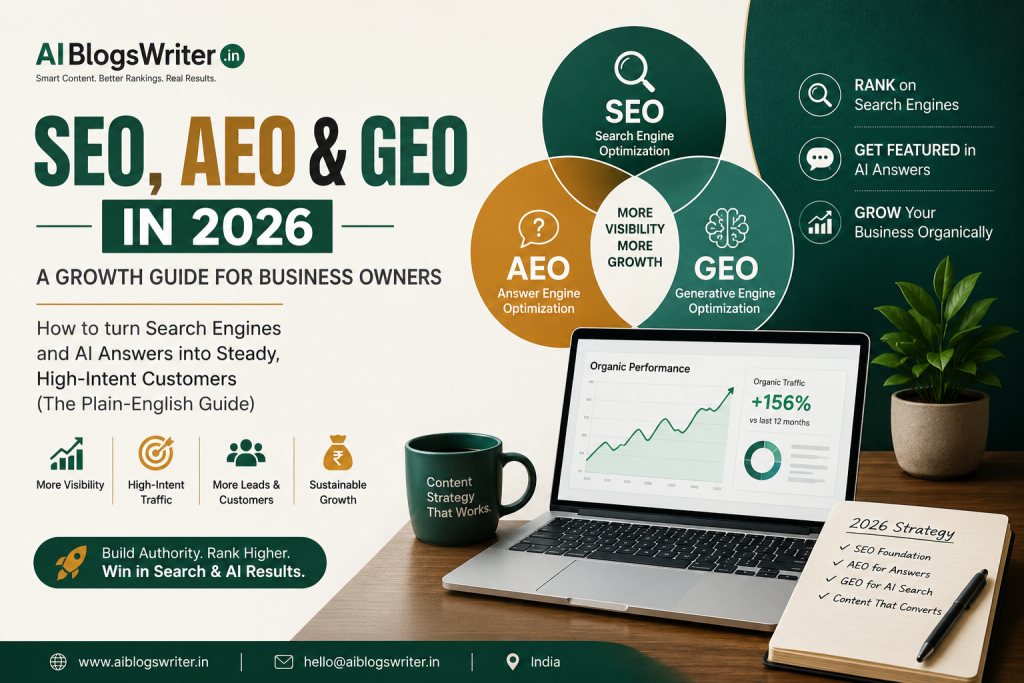
ToggleSEO, AEO & GEO in 2026: How to Get Your Business Found — Without Learning to Speak Marketing
You don't need to become an SEO expert to grow through search. You just need to understand what these three letters actually do for your revenue — and where to point your energy first.
Search Engine Optimization
Getting your business to show up when someone searches on Google.
Answer Engine Optimization
Getting your business quoted as the direct answer to a question.
Generative Engine Optimization
Getting your business recommended by AI tools like ChatGPT and Gemini.
Most guides to SEO are written by marketers, for marketers. They assume you already know what a "SERP" is, why a backlink matters, or what "crawl budget" means. This one doesn't. It's written for the person who actually signs off on the marketing budget — a business owner, a general manager, a founder wearing five hats — who wants a straight answer to one question: "Is this worth my time and money in 2026, and if so, where do I start?"
Short version: yes, it's worth it. Search is still where most buying decisions begin, whether that search happens on Google or inside an AI chat window. But the rules for winning that attention have quietly split into three related disciplines. Understanding the split — and picking the right entry point — is what separates businesses that grow steadily from businesses that spend money and see nothing back.
What actually changed by 2026
For almost two decades, "getting found online" meant one thing: ranking on the first page of Google. That's still true today, but it's no longer the whole picture. Two shifts changed the game:
- People now get answers, not just links. Google's AI-generated summaries and tools like ChatGPT, Gemini, Claude, and Perplexity increasingly answer questions directly, without the person clicking through to a website at all.
- Buying research now starts inside AI chat tools, too. A customer comparing options for a service or product may ask an AI assistant to recommend one before they ever open a search engine.
None of this makes traditional search irrelevant — people still search Google billions of times a day. It means your business now needs to be visible in three places at once: the search results page, the "quick answer" box above it, and the AI tools that quietly influence what your customers decide before they even talk to you.
The businesses that grow fastest in 2026 aren't the ones spending the most on ads — they're the ones that show up, consistently and credibly, everywhere a buying decision gets made.
SEO, AEO and GEO — explained the way you'd explain them to a friend
SEO: your digital storefront location
Search Engine Optimization is the practice of making your website easy for Google to understand, trust, and show to people searching for what you offer. Think of it as choosing a shop location on the busiest street in town, then making sure your sign, your window display, and your reputation all say "come in, we're exactly what you're looking for." It's a long-term asset: unlike ads, a well-optimized page keeps bringing in customers months and years after you publish it, without paying per click.
AEO: getting picked as the direct answer
Answer Engine Optimization is about structuring your content so that when someone asks a specific question — "what's the best CRM for a 10-person team" or "how much does X service cost" — your business is the one quoted as the answer, often in a featured box at the very top of the results, before any list of links even appears. It rewards clear, direct, well-organized answers over vague marketing copy.
GEO: getting recommended by AI
Generative Engine Optimization is the newest of the three. It's about making sure AI tools like ChatGPT, Gemini, and Claude actually know your business exists, understand what you do, and are willing to recommend you when someone asks for a suggestion. AI tools build their answers from trustworthy, well-structured content across the web — so if your business has never clearly explained itself online, in language a machine can parse, it simply won't get mentioned.
SEO gets you found. AEO gets you quoted. GEO gets you recommended. In 2026, you want all three working together — because your customer might meet your business through any one of them.
Why this matters for revenue, not just "traffic"
It's easy to dismiss SEO, AEO, and GEO as marketing jargon. But for a business owner, the real story is what happens to your cost of acquiring a customer over time.
- Paid ads stop the moment you stop paying. Organic visibility keeps working in the background, day and night, at no additional cost per visitor.
- Trust compounds. A business that consistently shows up as the helpful, accurate answer builds credibility that ads can't buy — and credibility shortens the sales cycle.
- It reaches buyers earlier. By the time someone fills out a contact form, they've often already researched, compared, and half-decided — frequently through an AI-assisted search. Being present in that research phase, worldwide, is how you end up on the shortlist.
In other words, this isn't a "nice to have" marketing project. It's closer to building a piece of infrastructure for your business — one that keeps generating qualified leads long after the initial work is done.
Finding your easiest win first: low-competition, high-intent keywords
Here's a mistake many business owners make: they try to rank for the biggest, most obvious phrase in their industry — something huge, generic, and already dominated by large, well-funded competitors. That's the hardest possible starting point.
A smarter approach is to target a phrase that is specific enough to have low competition, but clear enough to signal real buying or learning intent — the kind of phrase your ideal customer actually types, worldwide, when they're close to making a decision.
"how to grow your business with SEO AEO and GEO in 2026"
Supporting phrases worth weaving naturally through your own content include things like "SEO for business owners," "what is answer engine optimization," "what is generative engine optimization," and "organic traffic strategy 2026." None of these are exact figures pulled from a keyword tool — treat them as a strong starting hypothesis, then validate actual search volume and difficulty with a keyword research tool before you commit a content calendar to them.
You don't need the highest-volume keyword. You need the one where the person searching is genuinely close to becoming your customer. Ten visitors who convert beat ten thousand who don't.
A 6-step roadmap you can actually run
You don't need an in-house SEO department to start. Here's a sequence that works for a lean team or a single marketing hire.
-
Pick one focused topic and keyword
Choose a specific question your ideal customer is asking — not your whole industry. Validate it with real search data rather than guesswork.
-
Study what's already ranking
Look at the top results for that phrase. What format wins — a guide, a comparison, a tool? What's missing that you could add from real experience?
-
Write the direct answer first
Open your content with a clear, confident answer to the question in the first few sentences. This is what both readers and AI answer engines are scanning for.
-
Add what only your business can add
Real numbers, real client outcomes, your own process — the things a generic AI-written article can't fake. This is what earns trust and rankings.
-
Structure it for machines and humans alike
Clear headings, a short FAQ section, and a scannable structure help both search engines and AI tools understand and quote your content accurately.
-
Publish, link internally, and track it monthly
Connect the new page to related pages on your site, then monitor rankings and traffic every month rather than checking once and forgetting it.
Mistakes that quietly waste your budget
Chasing huge, generic keywords first. You compete against giant, established sites and see no movement for months.
Publishing AI-written content with no human review. Search engines and readers can both tell when nothing original was added.
Treating it as a one-time project. Search visibility is built and maintained monthly, not launched once and left alone.
Ignoring AEO and GEO entirely. Optimizing only for classic search misses the growing share of decisions influenced by AI answers.
How to know it's actually working
You don't need a marketing degree to read the scoreboard. Track four numbers, monthly:
- Rankings — is your target phrase moving up the results over time?
- Organic traffic — how many people are arriving from search without paid ads?
- Qualified leads or sales — of that traffic, how many turn into real business?
- AI mentions — periodically ask tools like ChatGPT or Gemini a question in your niche and see whether your business gets mentioned at all.
Explore related resources on AIBlogsWriter to go deeper on each piece of this roadmap:
Keyword Research for Non-Marketers
GuideAnswer Engine Optimization, Explained
GuideGetting Recommended by AI Tools (GEO)
ServiceDone-for-You AI-Assisted Content Writing
(Placeholder URLs shown above — replace with your live page paths on aiblogswriter.com before publishing.)
Frequently asked questions
Do I need to hire an SEO agency to get started?
No. A focused first topic, a validated keyword, and genuinely useful content can outperform a scattered agency retainer. Many businesses start with one well-researched page and expand from there.
What's the difference between SEO and GEO in simple terms?
SEO optimizes for search engine results pages. GEO optimizes for AI tools that generate a direct recommendation or summary instead of a list of links. Both rely on the same foundation: clear, trustworthy, well-structured content.
How long before I see results?
Most businesses see meaningful movement within three to six months for a well-targeted, low-competition keyword, with compounding gains after that as more pages are added around the same topic.
Can AI-written content actually rank well in 2026?
Yes, when it's reviewed, fact-checked, and includes real business experience or data a human added — not when it's published untouched as a generic first draft.